

Business automation for small business becomes necessary when the tools that once felt simple like WhatsApp and spreadsheets start collapsing under growth. Many small and growing businesses rely on these tools to run daily operations until their limits become impossible to ignore.
Most small businesses don’t fail because the founder isn’t smart.
They fail because the systems that worked at the beginning quietly collapse under growth.
At first, everything lives on WhatsApp. Orders. Clients. Team instructions.
Then comes the spreadsheet. Tracking payments. Delivery status. Expenses.
It works. Until it doesn’t.
This article isn’t about shaming manual tools. It’s about telling the truth that most founders avoid:
WhatsApp and spreadsheets don’t break because they’re bad. They break because your business outgrows them.
If growth feels stressful, chaotic, or fragile, this is for you.
Why WhatsApp and Spreadsheets Feel Like “Enough”
WhatsApp and spreadsheets survive early-stage businesses because they offer three things founders need desperately:
- Speed — no setup, no onboarding
- Control — everything is visible and personal
- Flexibility — rules can change daily
In the beginning, this is perfect.
You’re experimenting. You’re learning. You’re close to every customer.
Automation too early would actually slow you down.
So yes, the starting manual is not a mistake.
Staying manual forever is.
The Real Problem Isn’t Volume, It’s Complexity
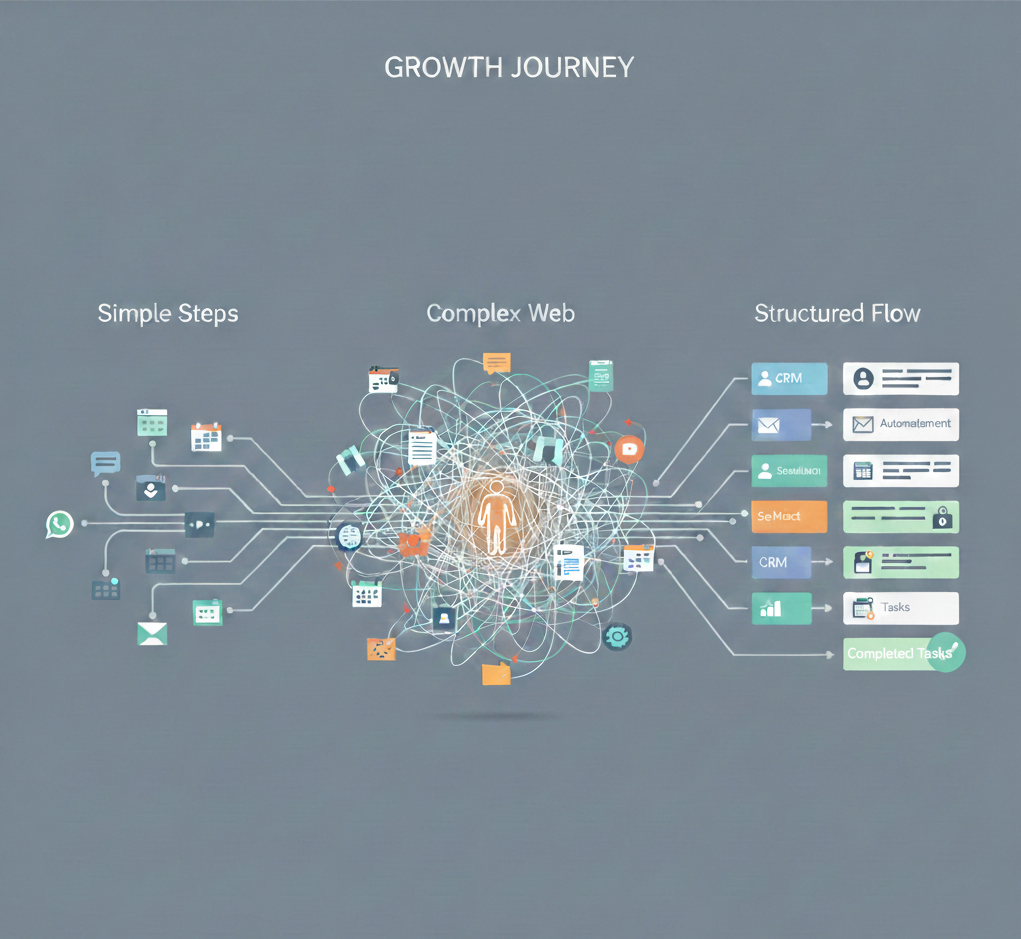
Most founders wait for “more customers” before thinking about automation.
That’s the wrong signal.
The real trigger is complexity.
Complexity shows up when:
- One customer has multiple requests
- One order affects multiple people
- One mistake creates a chain reaction
- One spreadsheet depends on another spreadsheet
At this point, effort increases faster than results.
You’re busy, but progress feels thin.
That’s not a hustle problem. That’s a systems problem.
Clear Signs WhatsApp and Spreadsheets Are Actively Hurting Growth
Quick Answer: Businesses should automate when manual tools cause repeated data entry, missed follow-ups, unclear reporting, and when the founder becomes the bottleneck for daily operations.
Be honest. If more than one of these is true, your systems are already costing you money.
These signs aren’t just inconveniences, they’re early signals that business automation for small business is overdue.
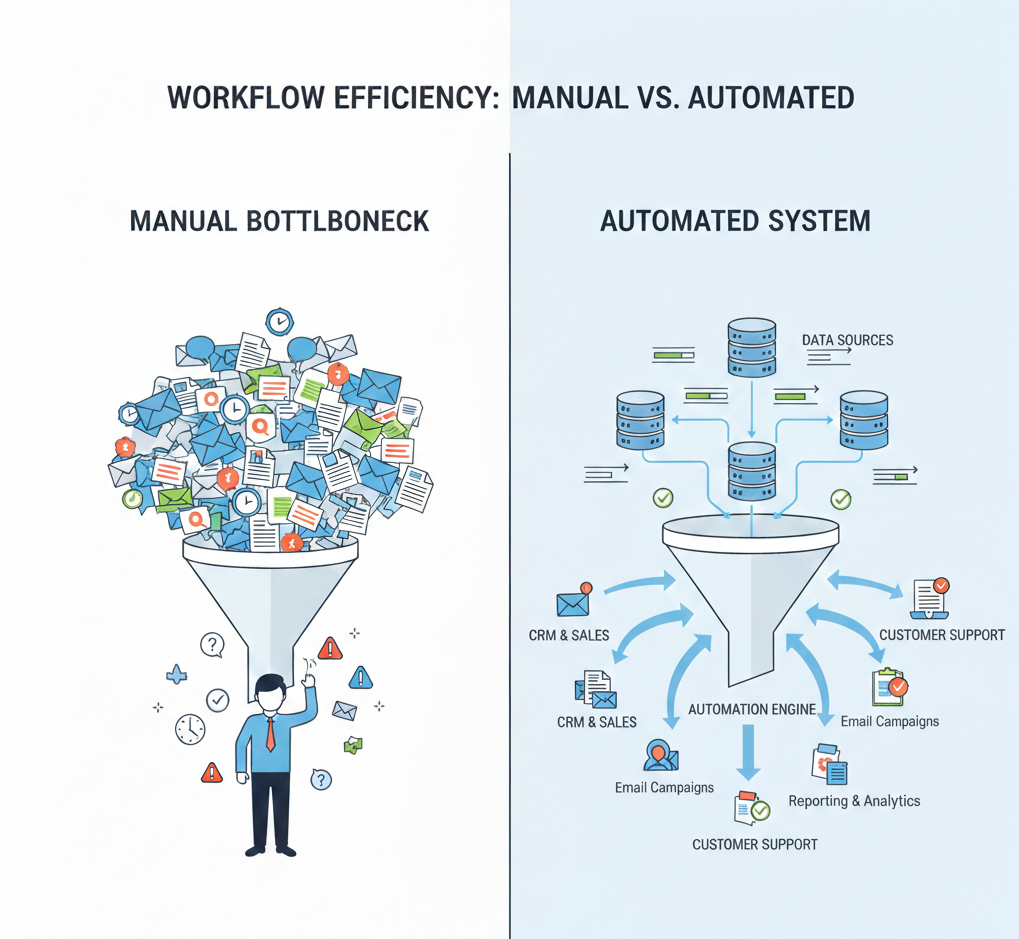
1. You Re-Type the Same Information Daily
Customer details move from WhatsApp → Excel → another sheet → someone else’s phone.
Every copy-paste is a failure point.
2. You Are the “System”
If you can’t step away for 48 hours without everything falling apart, you don’t own a company — your company owns you.
3. You Can’t See the Business Clearly
You have data, but not insight.
Spreadsheets tell you what happened, not what’s about to break.
4. Growth Feels Dangerous
More customers don’t excite you.
They worry you.
That’s the clearest sign your tools are too small for your ambition.
What Business Automation for Small Business Actually Looks Like
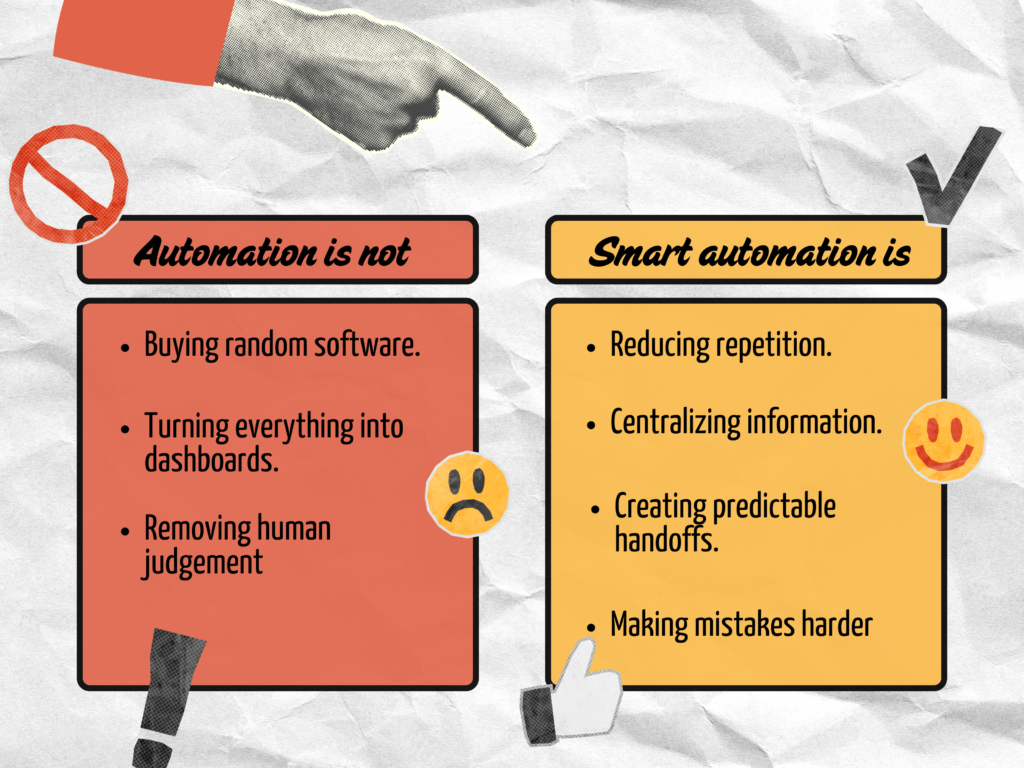
Done right, business automation for small business creates stability without removing human judgment.
What to Automate First
Don’t start with the entire business.
Start where friction is loudest.
1. Customer & Order Capture
Stop relying on chat history. Forms, structured pipelines, or lightweight CRMs turn conversations into usable data.
Tool suggestions:
- Google Forms / Tally – simple data capture linked to spreadsheets or dashboards
- HubSpot CRM (Free) – structured customer records and pipelines
- Zoho CRM / Notion CRM setups – lightweight, customizable systems for SMEs
2. Follow-Ups and Status Updates
If humans are responsible for remembering reminders, reminders will fail.
Automation doesn’t forget.
Tool suggestions:
- WhatsApp Business + Auto-replies – basic automation for common responses
- Zapier / Make – trigger follow-ups when forms are submitted or payments are made
- Calendly + Email/WhatsApp reminders – automated appointment confirmations
3. Reporting That Updates Itself
If reports require manual compilation, you’ll avoid them.
Automated reporting creates visibility without effort.
Tool suggestions:
- Google Sheets + automated formulas – first layer of reporting automation
- Looker Studio – live dashboards connected to Sheets or CRMs
- Notion dashboards – simplified internal reporting for small teams
4. Internal Handoffs
Once one step is done, the next person should be notified automatically.
No chasing. No guessing.
Tool suggestions:
- Trello / Asana / ClickUp – task automation and status-based triggers
- Slack or WhatsApp notifications via Zapier/Make – automatic alerts
- Simple workflow automations that assign tasks when stages change
How to Automate Without Breaking What Already Works
The fastest way to fail is trying to rebuild everything at once.
Instead:
- Document your current process, even if it’s ugly
- Identify where delays or errors happen most
- Automate one workflow end-to-end
- Test it in real conditions
- Improve, then expand
Good systems feel boring.
That’s how you know they’re working.
Automation Doesn’t Create Clarity, It Exposes It
If your process is unclear, automation will amplify the confusion.
Tools don’t fix thinking.
Before automation works, you must answer:
- Who owns this step?
- What triggers the next action?
- What does success look like?
Once clarity exists, automation becomes powerful.
Ready to Build Systems That Match Your Growth?
At Uptouch Media Labs, we help founders replace fragile, manual workflows with clear, scalable business systems without over-engineering or unnecessary tools. The goal of business automation for small business is simple: build systems that grow without breaking.
Learn more about our approach to business systems and workflow automation or explore how we help founders design scalable operations.
Stop managing chaos, build systems that let your business grow without breaking

One thought on “Business Automation for Small Business: When to Move Beyond WhatsApp and Spreadsheets”
wish you best and best