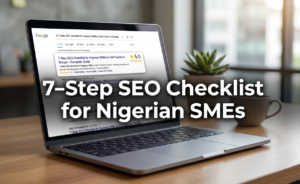
SEO Checklist for Nigerian SMEs: 7 Steps to Get Found on Google

An SEO checklist for Nigerian SMEs is essential for any business that wants to get found on Google. While having a website is important, the real challenge for many Nigerian SMEs is ensuring their customers can actually discover them online.

With increasing competition, rising ad costs, and more Nigerians searching online before making buying decisions, Search Engine Optimization (SEO) is no longer optional; it’s essential.

This checklist is for you if:

  • “You have a website, but no steady leads.”
  • “You rely heavily on Instagram or ads.”
  • “You want customers to find you organically on Google.”

Step 1: Set Up the Basics Correctly

Before advanced SEO tactics, ensure your foundation is solid. Without these tools, you are flying blind.

  • Install Google Analytics: Track where your visitors come from and what they do on your site.
  • Set up Google Search Console: Monitor your search performance and see which keywords bring people to you.
  • Submit Your Sitemap: Tell Google exactly which pages exist on your site.
  • Ensure Your Site Uses HTTPS: A secure connection is a ranking factor and builds trust.

Step 2: Do Keyword Research With Nigerian Search Intent

SEO starts with understanding what your customers are actually searching for.

Focus on keywords that reflect local intent, such as:

  • “Cleaning services in Abuja”
  • “Fashion designer in Lagos”
  • “Affordable catering services in Ibadan”

Tools to use: Google Autocomplete, Google Keyword Planner, or Ubersuggest.
Tip: Choose keywords with clear intent (e.g., “buy office chairs”) rather than just high volume (“chairs”).

Step 3: Optimize Your Website Pages (On-Page SEO)

Each page on your website should target one main keyword. Google needs to know exactly what a page is about within seconds.

  • URLs & Titles: Include your main keyword.
  • Clear Headings: Use H1, H2, and H3 tags to structure your content.
  • Meta Descriptions: Write a compelling “ad” for your page that shows up in search results.
  • Image Alt-Text: Give your images descriptive names so Google can “see” them.

Step 4: Create Helpful, Relevant Content

Google rewards websites that consistently provide value. As an SME, your content should answer the questions your customers are already asking:

  • How your service works or pricing explanations.
  • Industry tips (e.g., “How to effectively get rid of bedbugs”).
  • Case studies and FAQs.

Step 5: Master Local SEO (The Nigerian Advantage)

If you serve customers in specific neighborhoods or cities, Local SEO is your secret weapon. Most Nigerians search for “near me” or “[Service] in [City].”

  • Claim your Google Business Profile: Ensure your hours and phone number are 100% accurate.
  • NAP Consistency: Your Name, Address, and Phone number must be identical across your website and social media.
  • Reviews are Gold: Ask your happy customers to leave a review while they are still at your place of business.

Pro-Tip: Add a Google Map to your “Contact Us” page to help Google verify your physical location.

Step 6: Improve Website Speed and Mobile Experience

Most Nigerians browse the internet on mobile devices. Ensure your website:

  • Loads quickly, even on slow networks
  • Is mobile-friendly
  • Has simple navigation

Step 7: Build Credibility With Links and Mentions

Backlinks (where other websites link to yours) signal trust to Google.

  • List your business in credible Nigerian directories, such as VConnect or Connect Nigeria.
  • Collaborate with local industry blogs or news publications.
  • Quality matters more than quantity; one link from a reputable Nigerian site is better than 50 from random global sites.

Common SEO Mistakes Nigerian SMEs Should Avoid

  • Stuffing Keywords Unnaturally: Write for humans, not just robots.
  • The “Ghost Town” Profile: Setting up a Google Business Profile but never adding photos or replying to reviews.
  • Copy-Paste Content: Stealing text from foreign competitors. Google rewards original, local expertise.
  • Expecting Overnight Results: SEO is a marathon. The businesses that stay consistent are the ones that eventually own the market.

Case Study: How We Built a Lead-Generation Machine for Uptouch Cleaning Service

Proof that smart design + strategic SEO = Business Growth.

The Challenge

When we at Uptouch Media Labs took on the design for Uptouch Cleaning Service, they were invisible on search engines. They were stuck in the “social media hamster wheel,” only getting leads when they paid for ads.

Our Approach

To position Uptouch Cleaning Service for sustained organic growth, we implemented a focused, results-driven SEO strategy:

  • Mobile-First Website Design
    Built a fast, mobile-optimized website to match how Nigerian customers search and engage online.
  • Technical SEO Foundation
    Established a clean, secure, and crawl-friendly site architecture to support long-term search visibility.
  • XML Sitemap Submission
    Submitted structured sitemaps to ensure priority pages were discovered and indexed efficiently by Google.
  • Speed & Performance Optimization
    Optimized page load times to improve user experience, reduce bounce rates, and support higher rankings.
  • Clear Site Structure & Page Hierarchy
    Implemented logical content structure to help search engines quickly understand page relevance.
  • Intent-Driven Keyword Optimization
    Optimized pages around high-value, local search terms with clear commercial intent.
  • Meta Title Optimization
    Crafted keyword-focused titles to increase visibility in competitive search results.
  • Meta Description Optimization
    Wrote compelling descriptions designed to improve click-through rates, not just rankings.
  • Local SEO Alignment
    Strengthened location-based visibility by aligning website signals with Google Business Profile data.
  • Trust & Conversion Optimization
    Integrated reviews, clear contact paths, and enquiry forms to turn traffic into qualified leads.
Google Page One ranking for a Nigerian cleaning service website

The Result

Uptouch Cleaning Service now consistently ranks on Page One of Google for multiple core service keywords. The business receives a steady flow of high-quality inbound enquiries directly from search without spending a Naira on paid advertising.

What started as a simple website project has become a reliable revenue-generating digital asset.

Stop Chasing Leads. Start Attracting Them.

SEO is one of the most cost-effective ways for Nigerian SMEs to attract consistent, high-quality customers. But you don’t have to do it alone.

At Uptouch Media Labs, we specialize in helping Nigerian businesses build visibility, authority, and growth through expert web design and smart SEO strategies. Whether you need a new website or want to fix your current search rankings, we are here to help.

Ready to get found on Google?

Click to book a free 30-minute SEO audit of your website. Let’s help you turn searches into customers.

How to Choose a Tech Stack for Your Nigerian Startup In 2026: A Founder’s Guide to Scalability.

In Nigeria’s fast-growing digital economy, founders are building products that must operate in a challenging environment with inconsistent internet, rising operational costs, global competition, and users who expect speed, reliability, and simplicity from the outset.

Your tech stack determines whether your startup scales or crashes

It’s not just about what your developers prefer. 

It’s about selecting tools that align with your business goals, budget, team structure, and long-term vision.

This guide breaks down what Nigerian founders must consider when choosing a scalable tech stack in 2026.

What exactly is a “Tech Stack”?

A tech stack is the combination of tools and technologies used to build and run your product. It typically includes:

  • Frontend (user interface): Tools used to build what users see and interact with on a website or app. Examples: HTML, CSS, JavaScript, React, Next.js, Flutter.
  • Backend (business logic): Tools that power the behind-the-scenes functions like processing data, authentication, and API logic. Examples: Node.js, Express, Django, Laravel, Spring Boot.
  • Database (data storage and retrieval): Systems used to store, organize, and access application data. Examples: PostgreSQL, MySQL, MongoDB, Redis.
  • Infrastructure (hosting, DevOps, cloud): The environment where your app runs, including servers, deployment tools, and cloud services. Examples: AWS, Google Cloud, DigitalOcean, Docker, GitHub Actions.
  • Third-party integrations (authentication, payments, notifications): External services added to your app to enable specific features quickly and reliably. Examples: Paystack, Firebase Auth, Twilio, Stripe.

Why the Right Tech Stack Matters for Startups

Startups thrive on speed, flexibility, and scalability. A poor tech stack choice can lead to:

  • Slower development cycles
  • High infrastructure costs
  • Difficulty hiring developers
  • Poor product performance

But when chosen right, it becomes a strategic advantage.

Start With Your Business Needs, Not Technology.

Founders often begin with the wrong question:

“What framework should we use?”

The correct approach is to begin with:

“What business problem are we solving, and what capabilities does the solution require?”

Your stack should reflect:

A. The Stage of Your Startup

MVP stage: prioritize speed, affordability, and ease of iteration.

Growth stage: prioritize scalability, performance tuning, and modular architecture.

B. The Team You Have

Choose technologies your developers can work with confidently.

A skilled Node.js team will outperform a struggling Go or Java team every time.

C. Your Budget

Some technologies demand higher hosting fees, more specialized developers, or complex infrastructure.

Match Your Stack to Your Product Type

Different product categories require different capabilities. Below is a curated guide for Nigerian startups:

A. Marketplaces and Platforms (eCommerce, Logistics, Services)

Recommended:

Frontend: React or Next.js

Backend: Node.js (Express/NestJS) or Django

Database: PostgreSQL

Payments: Paystack or Flutterwave

Hosting: AWS or DigitalOcean

Why: Marketplaces require reliability, real-time updates, secure payments, and structured data handling.

B. Fintech Products

Recommended:

Backend: Java, Go, or Node.js

Database: PostgreSQL

KYC/Compliance: Dojah, IdentityPass

Hosting: AWS with strict security configurations

Why: Fintech requires high security, data integrity, compliance auditing, and transactional accuracy.

C. AI-Driven Products

Recommended:

AI/Backend: Python (FastAPI)

Frontend: React or Vue

Infrastructure: GPU-optimized cloud environments (AWS, GCP)

Why: AI workloads depend on strong Python ecosystems and powerful compute infrastructure.

D. Media, Content, and Streaming Platforms

Recommended:

Frontend: Next.js

Backend: Node.js or Django

Database: MongoDB

CDN: Cloudinary or Cloudflare

Why: These platforms require optimized media delivery, flexible content structures, and fast caching.

Prioritize Technologies With Strong Local Talent

Nigeria has a deep talent pool for:

Node.js

React / Next.js

Python (Django / FastAPI)

Laravel

Flutter

PHP

Choosing a stack with abundant local expertise reduces:

✔ Hiring difficulty

✔ Salary inflation

✔ Dependency on foreign developers

✔ Project delays

This is especially important for early-stage teams operating on tight budgets.

Plan for Scalability From Day One

Scalability is not just about handling more users; it’s about an architecture that supports growth.

Key scalability considerations:

  • Use cloud hosting instead of local servers (AWS, GCP, DigitalOcean).
  • Implement modular architecture or a “modular monolith” in early stages.
  • Use containerization (Docker) for easier deployment.
  • Add monitoring and logging (Sentry, Grafana, Datadog).
  • Adopt CI/CD pipelines for reliable releases.

Even if you don’t implement everything immediately, choose technologies that can evolve with increasing demand.

Cost Reality: Build With Nigerian Constraints in Mind

The Nigerian ecosystem requires founders to be mindful of:

  • Dollar-denominated cloud costs
  • SMS/OTP and API billing
  • Internet variability
  • Power fluctuations
  • Payment gateway uptime
  • Availability of affordable engineers

Choose a stack that allows you to maintain operations even during price fluctuations or infrastructure disruptions.

Avoid Over-Engineering

Many startups collapse under the weight of unnecessary complexity.


Avoid:

❌ Starting with microservices

❌ Using unfamiliar, trendy frameworks

❌ Overbuilding features for an unvalidated market

Start with:

✔ a simple backend

✔ a fast frontend

✔ a reliable database

✔ minimal third-party integrations

Your goal is to launch, learn from users, then scale.

The Tech Stack as Your Strategic Advantage

Your tech stack plays a central role in whether your startup will grow sustainably or struggle under pressure. 

The most scalable Nigerian startups build with:

✔ the right technology

✔ the right team strength

✔ the right architectural foundation

✔ the discipline to build lean and scale wisely

Choosing the right stack is not a technical decision alone; it is a strategic business decision that shapes the future of your company.

Ready to build a scalable digital product?

Uptouch Media Labs helps startups design, architect, and launch technology solutions built for growth.

👉 Book your FREE consultation today to start your project.

THE TRUE COST OF A BUSINESS WEBSITE IN NIGERIA (2025)

Why Are Website Prices in Nigeria So Confusing?

In 2025, one of the most Googled questions among Nigerian businesses is simple:

“How much does a website cost?”

But behind that question is frustration, the kind that comes from getting seven different price quotes that sound like they came from seven different planets:

  • ₦80,000 for a “quick website”
  • ₦250,000 for a “professional website”
  • ₦1.2 million for a “corporate site”
  • ₦5 million for a “full digital experience”

    Same Nigeria. Same year. Same request. So why the massive difference?

    Most business owners are not actually asking for a website; they’re asking for growth, trust, brand clarity, and a digital asset that brings ROI, but the industry keeps answering with just pages and plugins.

The Harsh Truth: Most Nigerian Websites Are Just Pretty Brochures.

Most Nigerian Small and Medium-sized Enterprises (SMEs) and startups pay for websites that look good but do nothing:

  • No strategy
  • No conversion
  • No growth

Which in turn results in a fine website that sits on the internet like a framed picture, meaning you’re leaving hundreds of thousands of Naira in sales on the table every month.
A ₦300k website with a strategy will outperform a ₦3m website without clarity.

Stop Asking “How Much?” Ask This Instead

Instead of asking: “How much should a website cost?”
The better question is: “How much is the website going to help my business grow?”
Because a website is only expensive when:

  • It doesn’t bring leads
  • It doesn’t increase trust
  • It doesn’t convert
  • It doesn’t support sales
  • It doesn’t tell your story
  • It doesn’t scale with you

A proper website is not a cost, it’s an asset.

And assets are evaluated by return, not price.

The 2025 Website Investment Tiers For Nigerian Businesses.

At Uptouch Media Labs, we categorize modern Nigerian business websites into three distinct tiers based on functionality and design sophistication. Use this blueprint to define your project scope and allocate your budget strategically.

The Non-Negotiable Core Costs (Annual Recurring Fees)

Regardless of your tier, every professional website requires annual foundational costs that must be factored into your long-term budget.

The Uptouch Media Labs Signature Model

This is where Uptouch Media Labs differentiates itself. Our process is designed to ensure you’re not just paying for a website; you’re investing in a digital asset built for clarity, trust, and measurable growth.

Step 1 — Discovery & Clarity Mapping

We uncover your business goals, audience behaviour, and positioning foundation.

Step 2 — ROI Blueprint

We create your user journey, conversion flow, SEO architecture, and funnel structure.

For example, after redesigning a client’s conversion flow, their bounce rate dropped by 47% in the first month simply because clarity replaced confusion.

Step 3 — UI/UX Experience Design

A clean, intentional, premium experience that guides users toward action.

Step 4 — Development + Integrations

Secure, fast, scalable development with modern tech stacks and essential integrations.

Step 5 — Launch + Optimization

Performance monitoring, continuous improvement, and monthly insights.

This is the strategic foundation behind every project we take on: strategy first, execution engineered for ROI.

SO HOW MUCH SHOULD YOUR WEBSITE COST?

Use this simple rule:

Your website cost = (Revenue goal × Brand positioning × Complexity) ÷ Time horizon

While every project is unique, we use this proprietary formula to ensure your investment is tied to tangible business outcomes.

If your goal is:

  • To look professional, the cost is low.
  • To convert, the cost is mid-range.
  • To scale, the cost is high.
  • To compete, the cost is premium.

Website pricing is never really about the website; it’s about the strategy behind the website.

The 2025 Mindset Shift

If your website is simply a digital version of your business card, almost any designer can build it.

But if your website is your sales engine, brand home, story space, and first impression, then the question is no longer:

“How much?”
It becomes:

“How far will this take my business?”

That’s where Uptouch Media Labs comes in, building digital experiences that don’t just look good, but work.

Ready to build a website that actually grows your business?

Book a Strategy Call with Uptouch Media Labs and let’s map out a clarity-driven, ROI-focused digital presence for your brand. 

5 Warning Signs Your Abuja Business Needs a New Website.

A web design agency in Abuja will tell you this: your website isn’t just an online address — it’s your 24/7 sales hub.

In a city as competitive as Abuja, first impressions matter. Whether you run a fashion boutique in Wuse, a restaurant in Gwarinpa, or a tech startup in Maitama, your website should reflect the quality and professionalism of your brand.

If you’ve invested in marketing but aren’t seeing results, your website is likely the problem. As a leading web design agency in Abuja, we understand the specific digital landscape, challenges, and high expectations of consumers in this region. Here are five signs that your Abuja business needs a new website

1: Your Website Is Not Mobile-Friendly

How a Web Design Agency in Abuja Builds Mobile-First Experiences.

The statistics are clear: the vast majority of Nigerians browse the internet using their mobile phones. 

If a potential customer searches for your services on their smartphone in a cab or while waiting for a meeting, and your website forces them to pinch, zoom, or scroll horizontally, you have already lost them to your competitors.

Investing in a responsive design that automatically adjusts to any screen size and device keeps visitors engaged and makes your brand look credible.

2: Your Competitors Look Better Online

How a Web Design Agency in Abuja Can Modernize Your Brand Image.

Your business has evolved; maybe you’ve rebranded, expanded your services, or refined your audience, but your site looks like it was built in 2010. 

Prospective clients will naturally assume your services are just as outdated.
Your website is a direct reflection of your business’s credibility and professionalism.

A new website allows you to align your brand identity(logo, colours, and messaging) with a professional design that says, “We are a serious business ready for the future.”

3: Your Website Loads Slower Than NEPA Restoring Power

Speed Optimisation Tips from a Web Design Agency in Abuja

Patience is a luxury that today’s internet users rarely possess. Studies show that if your website takes more than 3 seconds to load, nearly half of all visitors will abandon it.

Every second lost loading your site is a customer who has clicked back to Google to try your competitor. 

A new website built on a modern platform is optimised for speed from the ground up, guaranteeing a snappy experience that keeps visitors on your page and reduces friction on their path to purchase.

4: Your Site is an Information Dump, Not a Lead Generator

How a Web Design Agency in Abuja Designs High-Converting Websites.

A business website’s main job is to convert visitors into customers or leads. If you are getting traffic but no calls, it’s because your site lacks: 

  • Clear Calls-to-Action (CTAs)
  • Obvious “Book Now” or “Get a Quote” buttons
  • A simplified user journey to guide them 
  • Easy-to-find contact forms

A new website can be strategically designed with high-visibility CTA buttons, clear contact forms, and a simplified user journey. 

It moves beyond just showing information and actively encourages your Abuja customers to engage.

5: You Can’t Easily Update Content

Why a Web Design Agency in Abuja Recommends Modern CMS Platforms.

If you need to call a developer every time you want to update your business hours, announce a new product, or post a blog, your website is built on an inefficient system.

Your website is using outdated Content Management Systems (CMS), unsupported plugins, or ancient code that makes simple edits a frustrating and expensive chore. 

This technical debt also opens your site up to security vulnerabilities.

Running a business in Abuja demands agility. A new website built on a user-friendly CMS (like WordPress) gives you the power to manage your content instantly. 

This frees you from technical dependency, ensures better security, and makes it easy to keep your site fresh, which Google loves for better SEO performance.

Partner With a Trusted Web Design Agency in Abuja

An investment in a new website is an investment in your business’s future. 

If your current site shows any of these signs, it’s time to stop losing credibility and customers.

At Uptouch Media Labs, we specialize in helping Abuja businesses transform outdated websites into high-performing sales tools.

Ready to build a site that truly reflects your ambition?
Book your FREE consultation with our Abuja web design team today, and let’s create your most powerful marketing asset. 

 5 Reasons Why Your Website Isn’t Getting Any Customers And How To Fix Them

If your business website looks great but isn’t bringing in customers, this guide explains why and how to turn it into a conversion-driven growth engine.

You’ve spent money on a beautiful website. The design looks modern, the colors match your brand, and yet… nothing happens.

No inquiries. No new customers. Just traffic that comes and goes.

If that sounds familiar, keep reading. Many Nigerian businesses face a common challenge: having a visually appealing website that fails to deliver the desired results.

At Uptouch Media Lab, we’ve audited dozens of websites across Nigeria and found that the same five issues appear repeatedly. The good news is that they’re all fixable, once you know what to look for.

The Common Problems

Before diving into fixes, it’s essential to identify the underlying issues that are hindering many Nigerian business websites. Most of these challenges aren’t about having a bad product or a poor design; it’s about misalignment between what your audience expects and what your site delivers.

Your website should act as your digital salesperson, working 24/7 to attract, inform, and convert visitors into leads. But when any of its core systems, messaging, structure, performance, or analytics, fall short, the entire engine underperforms.

Let’s explore the five common reasons your website isn’t converting visitors into customers and how to turn things around.

1. Your Messaging Isn’t Clear Enough

When someone lands on your homepage, they should understand what you do within five seconds.

Split-screen comparing a flashy, chaotic website to a clean, conversion-focused layout.

If your headline says something vague like “Empowering Your Business Digitally,” you’ve already lost them. Visitors want clarity, not creativity.

 Fix: Use clear, benefit-driven language.

  • Instead of “We offer innovative digital solutions,” say “We build websites that attract customers and grow your business.”
  • Add a clear Call-to-Action (CTA) above the fold: “Book a free consultation,” “Get a quote,” or “See our work.”

    Your messaging should answer three quick questions:
  • What do you do?
  • Who is it for?
  • What’s in it for them?

2. You’re Getting Traffic But the Wrong Kind

Not all traffic is good traffic.
If your visitors aren’t your ideal customers, your conversion rate will always be low.

Luxury boutique filled with bargain shoppers looking confused, representing the wrong target audience.

For instance, if you sell high-end products but your SEO or ads attract bargain hunters, you’ll see clicks but no sales.

 Fix: Revisit your traffic sources.

  • Check your Google Analytics data: Where are visitors coming from?
  • Optimize for intent-based keywords, phrases like “hire a website developer in Abuja” or “software agency for SMEs in Abuja.”
  • Publish content that resonates with decision-makers, not casual browsers.

Remember, attracting the right traffic is better than chasing large numbers.

3. Your Website Isn’t Built for Conversion

Aesthetics don’t sell, structure does.
We often see Nigerian business sites designed like digital billboards: flashy, animated, but confusing.

Laptop screen showing a flashy, animated website filled with pop-ups and cluttered visuals.

 Fix: Apply conversion-focused design principles:

  • Keep your navigation simple, three to five main pages max.
  • Use white space to make reading easy.
  • Add social proof (testimonials, reviews, client logos).
  • End every page with a strong, action-oriented CTA.

Think of your website as a sales conversation, not an art gallery.

4. Your Site Is Too Slow (Especially on Mobile)

In Nigeria, over 80% of users browse on mobile, often with average data speeds.
If your site takes more than 3 seconds to load, you’ve already lost them.

A slow-loading website on a smartphone.

 Fix:

  • Compress large images before uploading.
  • Use a Content Delivery Network (CDN).
  • Minimize plugins (especially on WordPress).
  • Choose a reputable Nigerian hosting provider with a proven track record of reliable uptime.

You can check your website’s speed using Google PageSpeed Insights, aiming for a score of 85 or higher on mobile.

5. You’re Not Tracking or Optimizing

One significant reason businesses remain stuck is that they treat their website as a finished product instead of a living system.

Without analytics or tracking, you’re just guessing what’s working.

 Fix:

  • Set up Google Analytics 4 and Meta Pixel to track user behavior.
  • Use Hotjar or Microsoft Clarity to see how visitors navigate your pages.
  • A/B test different headlines, CTAs, and layouts.

    Continuous improvement turns an average website into a conversion machine.

Bonus Tip: Stop Treating Your Website as a Cost, It’s a Sales Asset

Your website isn’t just an online brochure; it’s the digital engine of your business. When built strategically, it works 24/7, generating leads, closing sales, and strengthening your brand credibility.

At Uptouch Media Lab, our web design services focus on blending beauty with measurable performance. 

We start every project with our Implementation Planner: a strategic discovery process that aligns your site with your business goals before design even begins.
That’s how we build websites that don’t just look good but work.

Business success after website optimization by digital experts

A website that doesn’t convert isn’t a failure; it’s feedback.
It’s your business telling you where the gaps are.

Start by clarifying your message, understanding your audience, simplifying your design, optimizing for speed, and tracking everything.Do that, and you’ll transform your website from an expense into a predictable growth engine.

🚀 Ready to make your website work harder?
Let’s build smarter. Grow stronger. Dominate digitally with Uptouch Media Lab.

The Hidden Cost of Using Website Templates for Your Growing Business

At first glance, website templates seem like a dream solution for small business owners. They’re affordable, quick to launch, and often marketed as “ready-made” solutions that can get your brand online in no time. 

With platforms like WordPress, Wix, and Squarespace offering thousands of options, it’s easy to see why many startups and entrepreneurs are drawn to templates. But as your business begins to grow and evolve, these cookie-cutter solutions can start to crack at the seams—quietly costing you time, money, and opportunities.

At Uptouch Media Lab, we’ve seen this firsthand. Many clients come to us after struggling with the limitations of templates. What seemed like a shortcut ends up becoming a costly detour. In this blog, we’ll break down the hidden costs of using website templates and why a custom-built website is often the smarter long-term investment for a scaling business.

1. Limited Flexibility Hurts Long-Term Growth

Most templates are built with general users in mind. 

That means they try to offer a “one-size-fits-all” structure that can accommodate different industries and business types. While this might work temporarily, the lack of flexibility quickly becomes obvious when your business requires specific features. 

Whether it’s advanced booking systems, custom pricing logic, third-party integrations, or dynamic content sections, templates rarely allow for deep customization without breaking the layout or requiring a patchwork of plugins.

Moreover, many templates use heavy themes, clunky builders, or rigid CSS structures that limit your ability to scale. Want to update your layout? Add a new product category? Run A/B tests or optimize user flows? 

You may find yourself battling the template instead of building on top of it. A custom website, by contrast, is designed from the ground up based on your needs and future growth. Every section is tailored to your goals, so you’re not held back when it’s time to expand.

2. Poor Performance Can Impact Conversions and SEO

Speed and user experience matter more than ever. Studies show that 40% of users will abandon a site that takes more than 3 seconds to load, and slow websites rank lower on Google. 

Unfortunately, templates often come bloated with unnecessary scripts, third-party tools, and generic styling that slow everything down. While these extras are included to offer flexibility, they end up hurting your website’s performance.

Templates also lack performance-optimized code. Unlike custom-built websites where developers fine-tune each line for speed and responsiveness, templates use standardized structures meant to serve multiple purposes. 

This can create friction points for mobile users, negatively impact bounce rates, and even affect your credibility. A custom-designed site is streamlined and efficient, helping you convert visitors into customers, not chase them away.

3. Templates Can Dilute Your Brand Identity

Your website is your digital storefront. It’s often the first impression people get of your brand. But when you rely on templates, that impression can feel generic. 

You’ve probably noticed it yourself—sites that look almost identical, using the same layouts, fonts, and design styles. 

That’s because hundreds, sometimes thousands, of businesses use the exact same template with only minor tweaks.

This lack of originality can harm your brand in the long run. A powerful brand experience is built through intentional design—your choice of visuals, tone, layout, interactivity, and storytelling.

A custom-built website enables this. It allows your personality to shine and your unique selling points to stand out. 

Whether you’re bold and edgy or elegant and minimal, a custom website supports your identity without constraints. At Uptouch Media Lab, we design websites that embody your brand, not just display it.

4. Security Risks Are Often Overlooked

Templates, especially free or outdated ones, can introduce serious security vulnerabilities. Most templates are built with multiple third-party plugins or external code dependencies that may not be regularly updated. 

When one of those plugins becomes outdated or compromised, your entire site could be at risk. If you’re running a business that collects customer data, processes payments, or even just maintains an email list, this kind of vulnerability can lead to lost trust and legal trouble.

With a custom website, however, the development process includes industry best practices for security. From HTTPS implementation to secure authentication and proper backend logic, your site is built with protection in mind. 

Plus, your development team can offer ongoing support and maintenance to keep things up to date—something template users often miss until it’s too late.

5. The Real Cost: Time, Rework, and Missed Opportunities

While templates may save you money upfront, they often result in higher costs over time. Businesses using templates eventually face challenges that require hiring developers to fix bugs, restructure layouts, or overhaul outdated sections. 

Add to that the missed revenue from slow loading speeds, bad mobile experience, low conversion rates, or poor SEO, and the price becomes clearer.

Additionally, if you need to rebrand or launch a marketing campaign, templates often become bottlenecks. Customizing them to align with new brand directions, seasonal offers, or sales funnels takes time and effort that a tailored system would’ve handled more efficiently. In contrast, a custom website is built to evolve. 

It grows with your business and gives you full control—saving you time, money, and creative energy in the long run.

Build Smart. Invest in Custom.

Templates might be a good starting point for side projects or temporary landing pages, but if you’re serious about your business growth, it’s time to invest in a solution that truly supports your goals. A well-crafted, custom website is more than a digital brochure—it’s your 24/7 salesperson, brand ambassador, and marketing engine.

At Uptouch Media Lab, we help ambitious businesses build high-performing websites that drive results. From user research and wireframes to development and post-launch support, we’re here to build digital experiences that scale with you. 

Ready to go beyond templates? Let’s build something extraordinary—just for you.

From Vision to Launch: Our Step-by-Step Web Design Process Explained

Creating a website is more than just placing text and images on a screen — it’s about crafting a digital experience that speaks to your brand, meets your goals, and engages your audience. 

At Uptouch Media Labs, we’ve designed a proven process that takes your idea from a simple vision to a fully functional, high-performing website. Whether you’re a startup or an established business, our step-by-step approach ensures clarity, collaboration, and results at every phase.

1. Discovery & Strategy

Every great website starts with understanding. In our discovery phase, we dive deep into your brand, target audience, and business goals. This is where we ask the right questions: 

  • What’s your value proposition? 
  • Who are your users? 
  • What do you want them to do on your site? 

From this research, we build a custom strategy tailored to your needs — one that outlines key features, user journeys, and content priorities. This step ensures that we’re building a site with purpose, not just aesthetics.

2. Wireframing & UX Design

With a clear strategy in hand, we move into wireframing — the blueprint of your website. This stage focuses on structure, layout, and user experience (UX). We sketch out the navigation flow, page hierarchy, and interactive elements to ensure every click has intention. 

Our goal is to make your website intuitive and easy to use. Before any visuals come into play, we validate the flow and functionality so users can move through the site seamlessly and find what they need quickly.

3. Visual Design & Branding

Now the creative magic begins. Our design team brings your brand to life with a compelling visual identity that reflects your values and captivates your audience. We choose fonts, colors, imagery, and animations that align with your brand voice. 

Each design is created in close collaboration with you, ensuring you’re part of the creative direction. At this stage, we also provide mockups for different screen sizes to guarantee a responsive and mobile-friendly experience.

4. Development & Testing

Once designs are approved, our development team transforms them into a live website using clean, efficient code. We build for speed, accessibility, and performance — ensuring your site works flawlessly on all devices and browsers. 

During this stage, we also integrate any necessary tools like content management systems (CMS), contact forms, booking systems, or e-commerce functionalities. Every feature is tested thoroughly for bugs, broken links, or usability issues before launch.

5. Launch & Support

It’s launch time — but our work doesn’t end there. After your site goes live, we conduct a final performance check and ensure everything runs smoothly. We also provide training (if needed) so you can manage your content with ease. 

Need ongoing support or future updates? We offer maintenance plans to keep your site secure, updated, and optimized. Your digital presence is now ready to make an impact, and we’ll be right beside you as it grows.

Whether you’re revamping an existing site or starting from scratch, our web design process is built to guide you every step of the way — from first idea to flawless launch. Let’s bring your vision to life. 

Ready to get started?

How a High-Converting Website Can Become Your 24/7 Sales Machine

In today’s digital economy, your website is more than just an online brochure — it’s your best salesperson. Unlike traditional sales reps, your website doesn’t sleep, take breaks, or go on vacation. It works 24/7, nurturing leads, closing deals, and building trust with potential customers. But for this to happen, your website must be optimized not just for aesthetics, but for conversion.

In this blog, we’ll break down how a high-converting website becomes a sales machine, the critical components it needs, and actionable tips you can start using today.

What is a High-Converting Website?

A high-converting website is one that effectively turns visitors into leads, and leads into paying customers. It’s built with purpose — every page, every element, every piece of copy is strategically designed to move users through a conversion funnel.

Conversion doesn’t always mean an immediate sale. It could be:

  • Signing up for a newsletter
  • Booking a consultation
  • Downloading a free resource
  • Making a purchase

The key is that the website is constantly helping visitors take the next step in their customer journey, automatically and around the clock.

Why Your Website Needs to Work Like a Sales Machine?

  1. Your audience is always online — Even when you’re asleep, people in different time zones or those browsing late at night are checking out your business.
  2. Consumers research before they buy — A high-converting website educates, builds credibility, and answers questions so potential customers feel confident.
  3. First impressions are digital — In most cases, your website is the first interaction a customer has with your brand. Make it count.

2. Strategic Call-to-Actions (CTAs)

CTAs are the closing lines of your website’s sales pitch. Every page should have a clear CTA — whether it’s to “Book a Demo,” “Download the Guide,” or “Shop Now.”

Tip: Make CTAs stand out with contrasting colors, action-oriented words, and strategic placement (above the fold, after benefits, near testimonials).

3. User-Centric Design and Seamless Navigation

A good user experience = more conversions. Your design should guide users naturally from interest to action.

Tip: Use visual hierarchy, intuitive menus, and consistent layouts. Avoid clutter. Think “How can I make this easier for the user?”

4. Lead Capture Systems

Include high-value lead magnets such as:

  • Free eBooks or guides
  • Email courses
  • Exclusive discounts
  • Free trials or consultations

Tip: Use exit-intent popups or embedded forms to catch interested users before they bounce.

5. Trust-Building Elements

Before users take action, they need to trust your brand. Add:

  • Testimonials
  • Case studies
  • Social proof (logos, follower counts, reviews)
  • Certifications and guarantees

Tip: Include real photos, video testimonials, or short case study success stories to increase emotional connection.

6. SEO Optimization

Your sales machine can’t work if no one visits it. Search Engine Optimization brings organic traffic your way, day and night.

Tip: Target long-tail keywords, create high-quality blog content, and optimize meta titles/descriptions for each page.

7. Speed and Mobile Optimization

Slow and non-responsive sites kill conversions. Your site should load in under 3 seconds and look great on any screen.

Tip: Use tools like Google PageSpeed Insights to test and improve your performance.

How to Measure Your Website’s Sales Performance

To truly operate like a 24/7 sales machine, you must track key performance indicators (KPIs) such as:

  • Conversion rate (visitors vs. actions)
  • Bounce rate
  • Average session duration
  • Cart abandonment rate
  • Leads generated/month

Use tools like Google Analytics, Hotjar, or HubSpot to gain insights and continuously optimize your pages.

Your Website is the Salesperson You’ve Been Looking For

When built strategically, your website can be the most efficient salesperson on your team. It doesn’t clock out. It doesn’t get tired. It’s always ready to sell — at 3 PM or 3 AM.

So ask yourself:

Is your website working for you or against you?

If it’s not generating leads, building trust, or converting visitors, it’s time to upgrade it into a high-converting, 24/7 sales machine.

Why Your Business Website Is Underperforming—And How Strategic Web Design Fixes It

In today’s digital world, your website is often the first impression potential customers have of your business. But what happens when that first impression falls flat? Maybe your site looks decent, but leads aren’t converting. Traffic is low. Bounce rates are high. Something just isn’t working.

The truth is: an underperforming website can silently cost you customers, credibility, and cash. The good news? Strategic web design can turn that around.

Let’s dive into why your website may be underperforming  and how thoughtful design can help fix it.

1. Poor First Impressions

Visitors shouldn’t have to “figure out” your website. If they can’t find what they’re looking for in a few clicks, they’ll leave.

What Fixes It:

  • A clear and intuitive menu structure
  • Highlighting key pages (e.g. Services, About, Contact)
  • Using breadcrumbs or search features for larger sites
 Good design simplifies navigation, helping users get where they need to go effortlessly.

2. Lack of Clear Calls-to-Action (CTAs)

Even if your site looks great, it won’t convert if you don’t guide users toward action. Do you want them to call, book, subscribe, or buy? If it’s not obvious, they won’t do it.

What Fixes It:

  • Prominent buttons like “Book Now,” “Get a Quote,” or “Shop Now”
  • CTAs placed at strategic points across the site
  • Strong microcopy that tells users what happens next

Strategic CTAs drive engagement and move visitors from curious to committed.

3. Slow Loading Times

A slow website frustrates users and kills conversions. In fact, a 1-second delay can reduce customer satisfaction by 16%.

What Fixes It:

  • Optimized images and code
  • Reliable hosting

Minimal plugins and scripts
 Strategic design includes performance as a priority, not an afterthought.

4. Not Mobile-Friendly

More than half of website traffic comes from mobile devices. If your site isn’t responsive, you’re missing out — big time.

What Fixes It:

  • Responsive layouts that adapt to all screen sizes
  • Mobile-first design thinking
  • Clickable elements spaced for finger taps

Designing for mobile users ensures your business looks good and functions well everywhere.

5. Weak Content and Visual Hierarchy

Your message may be strong, but if it’s buried in cluttered layouts or endless paragraphs, it’s getting lost.

What Fixes It:

  • Clear visual hierarchy: headlines, subheadings, spacing
  • Bite-sized content broken up with visuals
  • Highlighting key benefits, not just features

Strategic design helps your message shine and makes your content easier to digest.

Designing for mobile users ensures your business looks good and functions well everywhere.

6. No SEO Strategy

A beautiful website doesn’t matter if no one can find it. Many underperforming websites have poor search engine visibility.

What Fixes It:

  • SEO-friendly design structure (headings, metadata, alt text)
  • Fast load speeds and mobile optimization (Google ranking factors)
  • Keyword integration in both content and code

Designing with SEO in mind ensures your website gets seen by the right audience.

7. Lack of Trust Signals

Without elements that build credibility, visitors may hesitate to do business with you.

What Fixes It:

  • Customer reviews and testimonials
  • Trust badges or certifications
  • Portfolio or case studies
 Strategic design incorporates trust signals that reassure visitors and boost conversions

Strategic Web Design Isn’t Just Pretty — It’s Purpose-Driven

A strategic website does more than just look good. It’s designed with purpose:

  • To attract the right audience
  • Guide them through a seamless experience
  • And convert them into loyal customers

At its core, strategic design is about alignment — aligning your business goals with the user’s needs and behavior.

Final Thoughts: Don’t Settle for “Good Enough”

If your website is underperforming, you don’t need to start from scratch — but you do need a strategic redesign. Every element on your site should work together to drive results.

And the best part? Once your design is working for you, your website becomes a growth engine — not just an online brochure.

5 Critical Features Every Corporate Website Must Have in 2025

In today’s fast-paced digital world, your website is more than just an online brochure—it’s your first impression, your best salesperson, and your customer service assistant all rolled into one. As we move further into 2025, corporate websites must evolve beyond just aesthetics. They need to be strategic, functional, and user-centric to attract, engage, and retain both existing and new customers.
Whether you’re revamping your current site or building a new one, here are five critical features your corporate website must have to stay competitive and customer-focused in 2025.

1. Mobile-First, Lightning-Fast Performance

More than 60% of all website traffic now comes from mobile devices. In 2025, your website must be mobile-first, not just mobile-friendly. This means your website should be designed with mobile users as the primary audience, with desktop users being secondary.

What to include:

  • Responsive design that adapts fluidly to all screen sizes
  • Mobile-optimized menus, buttons, and images
  • Touch-friendly navigation and clickable elements
  • Fast load times (under 3 seconds)

Why it matters:
 Google now prioritizes mobile-first indexing, meaning your mobile site is what gets ranked. A fast, seamless experience keeps visitors engaged and reduces bounce rates—crucial for both SEO and conversions.

2. Clear Value Proposition and CTA Above the Fold

You only have a few seconds to capture a visitor’s attention. That’s why it’s critical to communicate what you do, who you do it for, and why it matters—all without the visitor needing to scroll.

Key elements:

  • A bold, clear headline summarizing your value proposition
  • Subheadings or short supporting text explaining benefits
  • A high-contrast call-to-action (CTA) like “Book a Demo” or “Get Started”

Why it matters:
 First-time visitors should instantly know what your company offers. A clear CTA guides users on what action to take next, helping convert traffic into leads or customers.

3. SEO-Optimized, Conversational Content

Great content is what brings users in and keeps them coming back. But in 2025, content needs to serve two masters: search engines and humans. Your website copy should be keyword-optimized without sounding robotic.

Best practices:

  • Use long-tail keywords naturally in your headlines and body text
  • Incorporate FAQs and conversational language that matches how users search
  • Break up content with bullet points, headings, and visuals for better readability

Why it matters:
 SEO ensures your website can be found on search engines, while engaging content keeps visitors interested. The right mix turns organic traffic into lasting relationships.

4. Social Proof and Trust Signals

In an age of scams and misinformation, trust is currency. Users need to see that you’re credible before they decide to buy from or work with you.

What to include:

  • Testimonials from satisfied clients
  • Partner logos and certifications
  • Case studies with real results
  • Press mentions and awards
  • SSL security badges

Why it matters:
 People trust other people. Displaying real feedback and third-party validation builds confidence and removes doubt, making it easier for visitors to take the next step.

5. Interactive, Human-Centered User Experience

People want more than just information—they want an experience. Your website should feel alive and intuitive, creating a journey rather than a dead-end.

Features to consider:

  • AI-powered chatbots or live chat for instant assistance
  • Personalized content based on user behavior or location
  • Interactive elements like calculators, quizzes, or product configurators
  • Clean navigation with clear user flows (especially for B2B sites)

Why it matters:
 When users can engage with your site instead of just reading it, they stay longer, trust more, and convert at higher rates. A great UX turns curiosity into conversion.

Final Thoughts

In 2025, having a good-looking website is no longer enough. Your corporate site must be fast, clear, trustworthy, optimized, and built with the user in mind. These five features not only future-proof your digital presence but also help you attract new customers, retain existing ones, and stand out in a crowded market.

If you’re planning a redesign or want to audit your current site, use this checklist as your foundation. Investing in these features today means stronger growth and deeper customer relationships tomorrow.